Ok Im Back at It Again With the Vans
Back in 2002, when Rian Pozzebon, who was then a relative unknown in the sneaker customs, got the offer to bring together Vans and assistance rebuild the brand's ailing skate shoe program with his longtime friend and colleague Jon Warren, he had ane big question: "Will they let us mess with the classics?"
At the time, Vans wasn't particularly interested in cadre models like the Slip-On, Old Skool, and Authentic. "The classics but kind of existed," says Pozzebon. "But they weren't pushed." Instead, they languished—in just a few basic colors—in Vans stores.
The company's focus was directed elsewhere, on newer styles. After riding the moving ridge of the '90s skateboarding boom, Vans faced new contest from younger skate shoe brands similar DC and Osiris. These companies—born only a few years earlier—favored a chunkier, more tech-forward silhouette (a word the fashion customs uses to describe the shape of a shoe). Vans' retro styling, by comparison, felt stale. By the early on years of the new millennium, near a decade of sustained growth had fallen off—every bit had customers' goodwill.
SHOP VANS
"I merely never took it seriously every bit a lifestyle shoe. At all," Brian Trunzo, senior menswear trend forecaster at WGSN, says of his feelings about Vans at the time. Aggress by new competition in its core skate market and ignored by trendsetting sneakerheads who preferred the Air Force 1 or Adidas Superstar, Vans seemed on the verge of slipping into irrelevance.
And here was Pozzebon—not even an employee yet—asking if he could look backwards instead of forwards to inform his design decisions. It was a assuming question, to say the very least. And yet. "When nosotros came and interviewed they were like, 'Whatever it takes. Whatever y'all need,'" he recalls. Whether or not he fully knew it at the time, he'd landed on something that would prove crucial for the make'due south future success.
"It was that vintage piece," says Pozzebon, now the visitor'southward Lifestyle Footwear Design Managing director. "At the time, Vans didn't necessarily know what they really had."
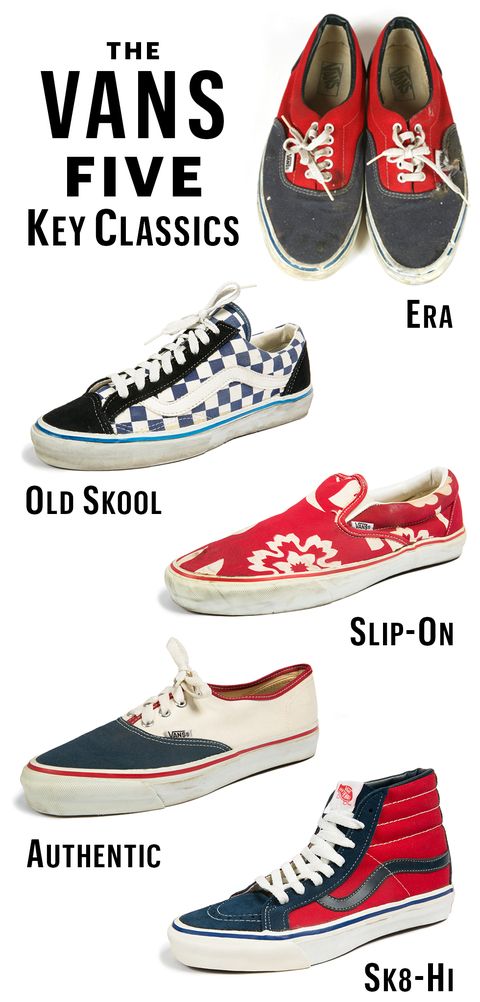
By focusing on that element of the company'due south Deoxyribonucleic acid, Pozzebon and his design team led Vans through a turnaround that was nothing brusk of staggering. The brand has go a staple of American footwear culture, on the level with iconic brands like Converse (which is twice equally old) and Nike (which is virtually x times every bit large). Vans are worn by celebrities and manner influencers, the jeans and T-shirt oversupply who rarely pay attending to what'south stylish, teenagers and toddlers, alike. What makes information technology all the more impressive—especially in an age of unprecedented technological innovation—is that it leaned on just five archetype styles to bulldoze its cultural relevance, which arguably has never been college, as well equally its sales, which have inarguably never been higher.
SHOP SK8-Hello
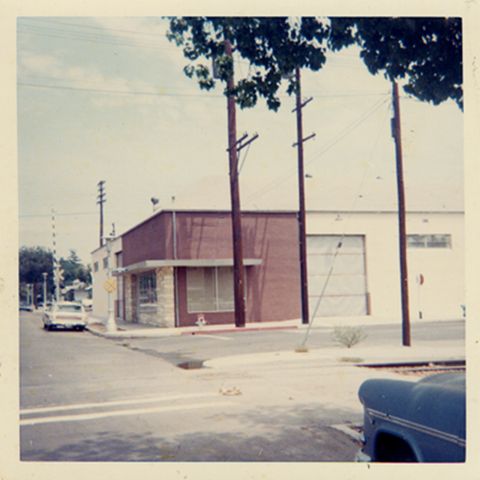
The Van Doren Rubber Company opened at 704 Eastward. Broadway in Anaheim, California, on March xvi, 1966. Founded by brothers Paul and Jim Van Doren (along with business partners Gordon Lee and Serge Delia), the company—which got its name from Van Doren—was unique in that it manufactured shoes onsite and sold them directly to the public. The shoes themselves were unique for some other reason.
"When my dad congenital the company—the shoe—he made the outsole twice as thick as the other competitors at the time," says Steve Van Doren, Paul's son and, officially, Vans vice president of events and promotions. (Unofficially, with his laid-back amuse and dizzying enthusiasm, he's basically the spirit of the make, personified.) Though the first Vans archetype—style #44, at present known as the Authentic—was conceived as a deck shoe, information technology wasn't too long before early skateboarders took note of the increased durability and the grip the at present-signature waffle soles provided.
SHOP Authentic

By the mid-'70s, skateboarding was a genuine phenomenon, with its own set of rising stars. Vans chop-chop noticed, driving guys like Stacy Peralta, Tony Alva, and Jerry Valdez—all three of whom would get legends of the sport—from location to location in a van, and hooking them up with sneakers. Van Doren saw it as an like shooting fish in a barrel tradeoff. A few free shoes for the guys in commutation for entrée into a whole new community.
That year, with the assistance of Alva and Peralta, Vans launched the Era. Its padded neckband provided some extra ankle protection, and it apace became the skater's shoe of choice. The Onetime Skool, the kickoff pair to feature the signature Vans "jazz" stripe, arrived a yr subsequently in 1977, followed by the Sk8-Hi in '78.

"I'm then loyal to them," Van Doren says of the skaters, surfers, and other athletes who wore Vans in the early days. "They made our visitor. It was a pocket-size, footling thing versus football and basketball and baseball, but they're super loyal."
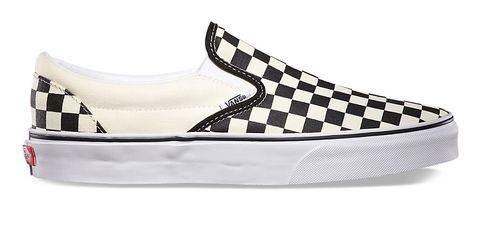
The '80s, for its part, brought both highs and lows for Vans. On the high side (in all senses of the word) were Sean Penn'southward Jeff Spiccoli and his checkerboard Skid-Ons. Though the style debuted in '77, it took Fast Times at Ridgemont Loftier'due south iconic stoner to launch the shoes—and the pattern—into the international spotlight in 1982. Van Doren says the thought for the assuming graphic was inspired by Vans' customers. They were coloring in the midsole on their own, and the make took note. Despite its at present-iconic status, the decision to motion the motif from the sole to the canvass uppers of the shoes wasn't a huge one at the time. As Van Doren recalls, it simply boiled downwardly to: "OK, we'll move information technology upward."
Store SLIP-ON
The company took the souring profits from its core styles and poured them into new ideas, like athletic sneakers designed for everything from volleyball to break-dancing. Information technology was an enormous fault, and Vans overextended itself. In 1984, the company filed for Chapter 11 bankruptcy protection, paid back its $12 million in debt by 1987, and was sold to the banking business firm McCown De Leeuw & Co. in 1988—the aforementioned year it debuted Steve Caballero's signature skate shoe.

By the time the '90s rolled around, things were looking up once again. An IPO in 1991 took the company public, a partnership with the Warped Tour that started in 1995 would create the longest-running concert serial in America, and a cultural obsession with all things skate made growth all simply inevitable. For a time.
"We've been through ups and downs in this company's history," says Van Doren. "We've had it 51 years, and sometimes we lost our way." So, in 2002, after a decade of success was met with a faltering bottom line and a sense of indifference from Vans' customers, Jon Warren and Rian Pozzebon got a phone call.
There were missteps, especially at the start. "I wait at the first collection I always built, and there'south some crazy wild shoes," says Pozzebon. "They don't even wait like Vans shoes." They were too technical, also experimental. "There was, like, ventilation through the bottom."
For many young sneakerheads at the time, Vans had, again, lost its way. The new looks were, at best, irrelevant, and, at worst, downright corny.
But that start collection also included the key to Vans' eventual success. "Nosotros took a bunch of classic silhouettes and rebuilt them, trying to make them as close as they could be to the original The states specs." The new riffs on the one-time models were simply allowed to be sold to specialty stores, not relegated to the back of Vans' ain shops or mass distributors. "That was the showtime beginnings of people starting to—inside the company fifty-fifty—look at the quondam stuff."
Not long later on, in 2003, the Vault collection was conceived, a high-end accept on the classics designed to catch the attention of influencers and boutiques akin. "That's 14 years ago," says Pozzebon. "So as you starting time to win that over, it eventually trickles downward to where retro is as popular as it is, and people look to Vans equally something authentic for it."
"They were harvesting relevancy—putting in the work years and years ago to ensure time to come success," says WGSN trend forecaster Trunzo.
Shop ERA

In that location was another element at play, also. In 2004, Vans was caused for $396 meg in cash by North Carolina-based VF Corp., which also owns The N Face, Timberland, and Nautica (to name a few). "I was in China that day and got a call saying, 'We've been bought! Past a company chosen VF,'" Van Doren says. "OK," he asked himself at the fourth dimension, "what'due south that mean?"
Though and then many stories become the other fashion, in this case, it meant good things. I of the OG clothes giants—it was founded in 1899—VF has an impressive reputation, especially when you consider the pall that hangs over holding companies and conglomerates in many consumers' minds. "VF Corp. is really good at being a steward and a parent of companies," says Trunzo. "I feel like every brand in their portfolio gets the proper sort of attention and marketing dollars—and the proper opportunity to explore their heritage, be authentic, and grow."

Post-acquisition, that meant exploring its range of classic styles even further—especially after the re-released Slip-On became popular. "That was kind of the beginnings of Classics starting to go upwards," says Pozzebon.
Trunzo recalls being in New York in 2005 and noticing the trend taking hold. "The checkerboard slip-on was starting to kind of get cool with the downtown New York hipster crowd," he says. Of course, once the influencers embraced it and the style started the inevitable journey into mass consciousness and popularity, there was really merely one mode for the situation to go: The market place started to flood with cheap knockoffs.
It's not all bad, though. According to Pozzebon, the competition ultimately forced the popularity of the Slip-On to subside, which meant Vans could phone call attention to its other styles. "Nosotros're not merely the Slip-On," he says, "we also accept this."
SHOP OLD SKOOL
"This" generally means one of five fundamental classics: the Authentic, Era, Old Skool, Sk8-Hi, and Slip-On. (Pozzebon would like to see the Chukka join the fray; Van Doren likes the One-half Cab.) Depending on which style tribes you've kept your eye on for the last few years, you've probable seen that one or all of them make its way into (and out of) the limelight. There are the mail service-Tumblr #menswear guys adopting the Accurate equally a go-to casual sneaker cheers to its lack of bells and whistles. The Instagram-fed cool kids rocking the Sk8-Howdy precisely because of the bells and whistles—the padded collar, the jazz stripe, the high-top silhouette. Or pretty much every guy wearing Erstwhile Skools recently.
"I feel like the Old Skool is probably a new shoe for and then many people who've been a function of Vans," says Pozzebon. "They've just never looked at that one. And here information technology is, and I'm shocked."

The surprise is understandable. Though it previously put upwards the "smallest numbers" of the Classics programme, the Old Skool has been enjoying a renaissance since last twelvemonth, when guys like A$AP Rocky and Frank Ocean made it an unofficial part of their uniform. Add to that collaborations similar the i with legendary SoCal sneaker shop Blends (which brought back the rare "bones" side stripe) and the ongoing reworking of the shoe by Supreme (which has been toying with the style since dorsum in '96), and it makes sense that folks are rediscovering the silhouette. It'due south nearly impossible to walk downwards the street in 2017 and not grab at least i person—from self-aware fashion types to regular jeans-and-a-T-shirt guys—wearing a pair.
"I call back people know that they tin can keep coming back to Vans and we're changing and evolving the shoes and having fun with them, but it's never leaving their foundation and their condolement zone," says Pozzebon, noting, in addition to the Old Skool, new styles like the UltraRange that up the technology but keep the way cues of the classics. "I'll exam them and challenge them, simply there'due south a existent honesty to information technology all that it keeps people going through the different silhouettes and having fun with them."
Every bit Van Doren says, "it's overnice to not but accept one shoe."
Even so, the listing is short. And, at this signal, that's by design. After the over expansion of the '80s and the rudderless design philosophy of the early 2000s, Vans seems keenly aware of what it takes for the make to be successful: actuality.
"If Vans released a knitted sneaker right now, I feel like you'd just exist similar, 'Are yous fucking serious? Yous tin't skate in that,'" says Trunzo, who credits Vans' electric current success, in part, to the popularity of the early-'90s, skate-inspired look that'due south get a driving force in the mode world. "But the fact that they kept the ship steering in the correct management—sticking to the game plan—obviously resonated with their core customers," he says. "The ones who have the heritage are going to have the advantage. You tin't make that shit up."
"We're not trying to create what nosotros think people desire us to be. Nosotros endeavor to go out and stay who nosotros are, and try to notch up," says Van Doren. "You're not going to see us, every bit long as I'chiliad effectually, having a basketball game shoe or a football cleat. We did in the early '80s; we had football, basketball, racquetball, wrestling, skydiving, interruption-dancing… But nosotros most went out of business. And then nosotros had to come back to earth and go back to what we do. And we learned that lesson well."
Shop VANS
They learned it very well. Vans has become a $2.3 billion powerhouse—VF Corp.'south largest and fastest-growing brand, with a gleaming new headquarters in Costa Mesa to testify for it. "The ongoing energy and estrus behind the Vans brand continues to abound," Rendele said during VF'southward latest quarterly earnings call on Oct 23, 2017. Among the notable successes: the iconic checkerboard motif, the Old Skool, and the UltraRange. All part of, or inspired by, the Classics. He went on to preemptively quell any worries about the future: "Some of yous may be wondering whether this level of growth for Vans is sustainable. Let me only say, the conviction nosotros have in our largest brand is high. The brand is stronger than it has ever been."
Will information technology stay that way? Perhaps—if the folks in charge take the lessons of past failures to heart. "There has to be some lineage and some ties to the shapes and patterns that be in Classics," says Pozzebon of the overall Vans blueprint ethos. Otherwise, that lack of authenticity—of honesty—could terminate the job that straying from the core Vans identity nearly did in 1984.
Merely information technology's been 33 years (and a couple of billion dollars) since those days. And Steve Van Doren, as always, seems certain that the company his male parent and uncle founded 51 years agone is on the right path. "I always try to keep my thoughts on Classics," he says. "I'grand actually also old school. But that's the way nosotros're gonna stay."
This content is created and maintained past a tertiary party, and imported onto this page to help users provide their email addresses. You may be able to find more information about this and similar content at piano.io
andersonhitheree1956.blogspot.com
Source: https://www.esquire.com/style/mens-fashion/a13446025/vans-shoes/
0 Response to "Ok Im Back at It Again With the Vans"
Post a Comment